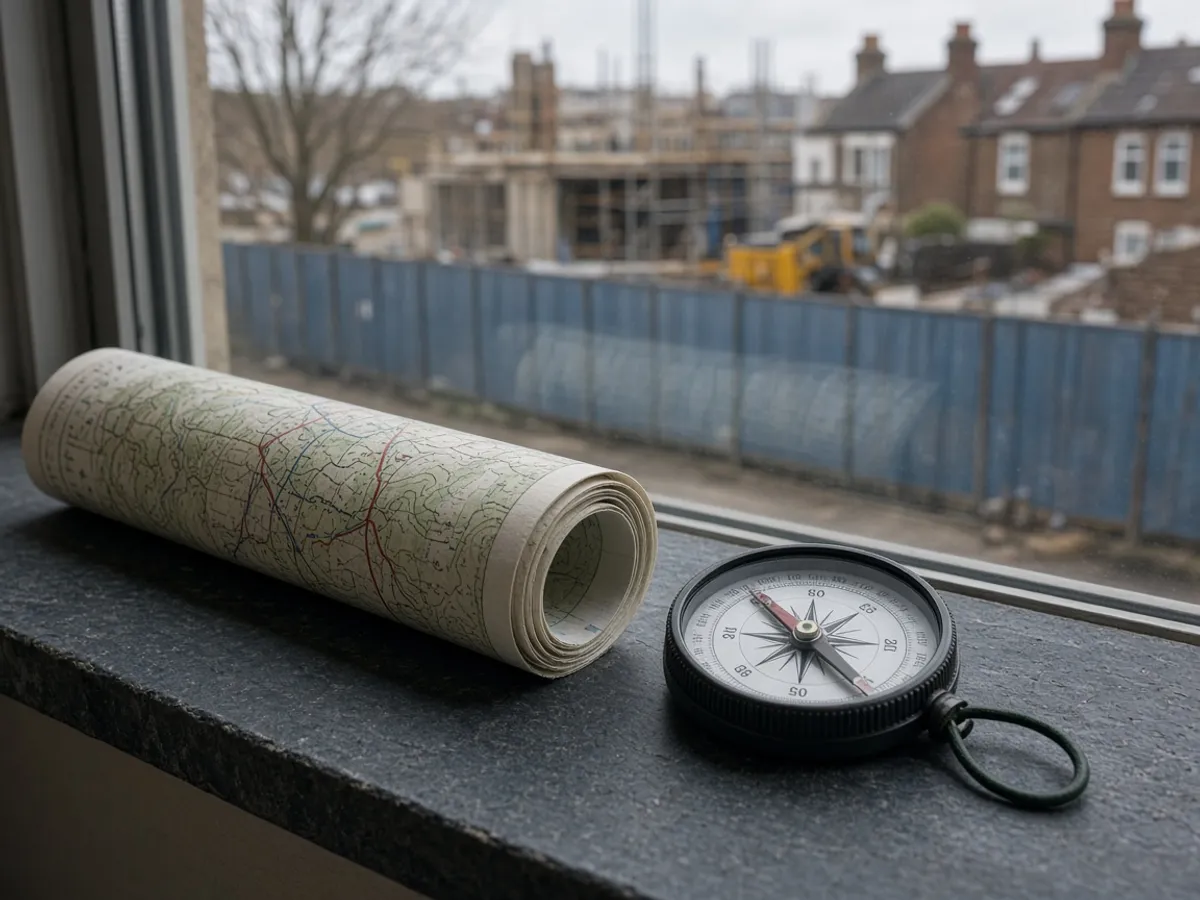
A survey visit is short. The things that waste it are ordinary: a locked side gate, a dog with opinions, a skip where the control station needed to stand, and a client who is in Prague. This is a checklist, not a scolding.
Access is the brief
Say how we get from the highway to the back hedge. If the only route is through a kitchen, say who will be home. If a London mews has a coded gate, send the code or a person. If a Digbeth yard will be full of wagons, say the quiet hour. We will not invent permission to stand on a neighbour’s wall.
Vegetation hides ground. If you want the fence, not the bramble, cut what you can before we arrive. We are not a landscaping gang and we will not chainsaw a conservation hedge because the drawing would be prettier.
What to leave on the table
Any existing CAD you still trust, even if it is old. Title plans if the line matters — read title plans first. A sentence about purpose: planning, earthworks, legal. The formats your architect can open. That is enough to stop us guessing the contour interval.
Safety and the unglamorous list
Live railways, quay edges, fragile roofs and occupied schools all change the method. A drone may be refused for reasons that have nothing to do with price. Dogs and cattle are field hazards; lock them away or walk them off. Loft hatches that have not been opened since 1998 are a building survey problem — tell us before we bring the wrong ladder.
After the visit, expect questions, not silence. A missing room or a flooded chamber will show up in the file as a hole if we do not tell you. The contact form is the right place to add a postscript. If you want the longer product story, start at topographical surveys and work sideways.
A morning-of list
Unlock the side gate. Move the car that sits on the only place a tripod can see both gables. Put the dog in a room that is not being measured, or walk it. Tell tenants we are not valuing the sofa. If you promised a loft hatch, put a ladder you trust next to it. If the alarm will scream, say how to stop it.
On commercial land: induction rules, PPE, the name of the person who can open the compound, and whether a live crane will swing through the only sky a drone could have used. On rural land: livestock, the bull you forgot to mention, and the field that is actually a bog after Tuesday’s rain.
After we leave
You will get questions if a room was locked or a chamber would not lift. Answer them quickly if you want the file this week. When the drawing arrives, open it. If your architect cannot xref it, say so in the first twenty-four hours. Revisions for scope you added later are variations. Revisions for a missing feature that was in the brief are our problem.
The form is the right place to add a postscript about a new skip or a new tenant. The topographical surveys page is the right place to start if you still have not named the product. Either way, a prepared site is the cheapest efficiency left in the process.
A last pass before you hit send
Unlock the gate. Move the car. Put the dog away. Send the code. Send the CAD you still trust. Send the title if the line matters. Send the timetable if the building is alive. After we leave, open the file. The cheapest efficiency left is a site that was ready.
If you want the product rather than the essay, start at topographical surveys or the contact form. The phone and inbox on this site are temporary; the brief you type is the reliable object.